
There, I said it.
If you run a small business and someone told you, “Just use Shopify,” you probably didn't ask enough questions.
And if you're already paying Shopify every month, don't worry. You can keep telling yourself that it's the easiest solution.
But here's the uncomfortable question:
Are you actually using Shopify because it's the best platform for your business, or because everyone told you to use Shopify?
Because those aren't the same thing.
“But Shopify Is So Easy!”
Yes.
That's the point.
Shopify is incredibly good at getting someone from “I need a store” to “I have a store” quickly.
And for some businesses, that's fantastic.
But small businesses don't necessarily need the easiest platform to launch.
They need a platform that makes sense for the business they're actually building.
There's a difference.
You can open a Shopify store remarkably quickly.
Congratulations.
Now comes the fun part:
Paying for it. Customizing it. Extending it. Adding apps. Paying for those apps. Maintaining those apps. And eventually discovering that the “simple” store isn't quite as simple anymore.
Shopify's Biggest Advantage Can Become Its Biggest Weakness
Shopify gives you an ecosystem.
- Themes.
- Apps.
- Payments.
- Analytics.
- Marketing tools.
- Integrations.
It's convenient.
But convenience has a price.
And I'm not talking only about the monthly subscription.
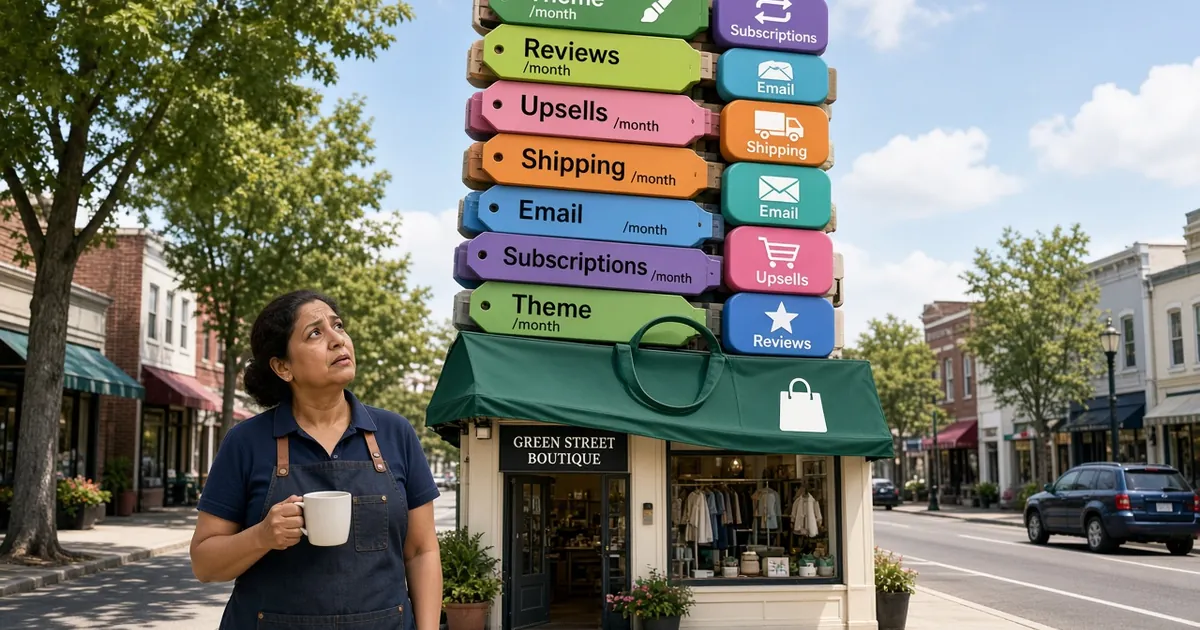
Your store can slowly become an apartment building made out of monthly subscriptions.
Need advanced reviews?
App.
Need better subscriptions?
App.
Need a particular shipping feature?
App.
Need advanced product options?
Probably another app.
Need something your theme doesn't do?
Time to start looking at apps again.
Before long, your “simple online store” has accumulated a collection of third-party dependencies that you're paying to keep alive.
And Shopify users will often respond:
“But the apps are cheap.”
Sure.
One app is cheap.
Five apps are manageable.
Ten apps?
Now we're having a different conversation.

Here's the Question Shopify Users Should Ask
Instead of asking:
“How much does Shopify cost?”
Ask:
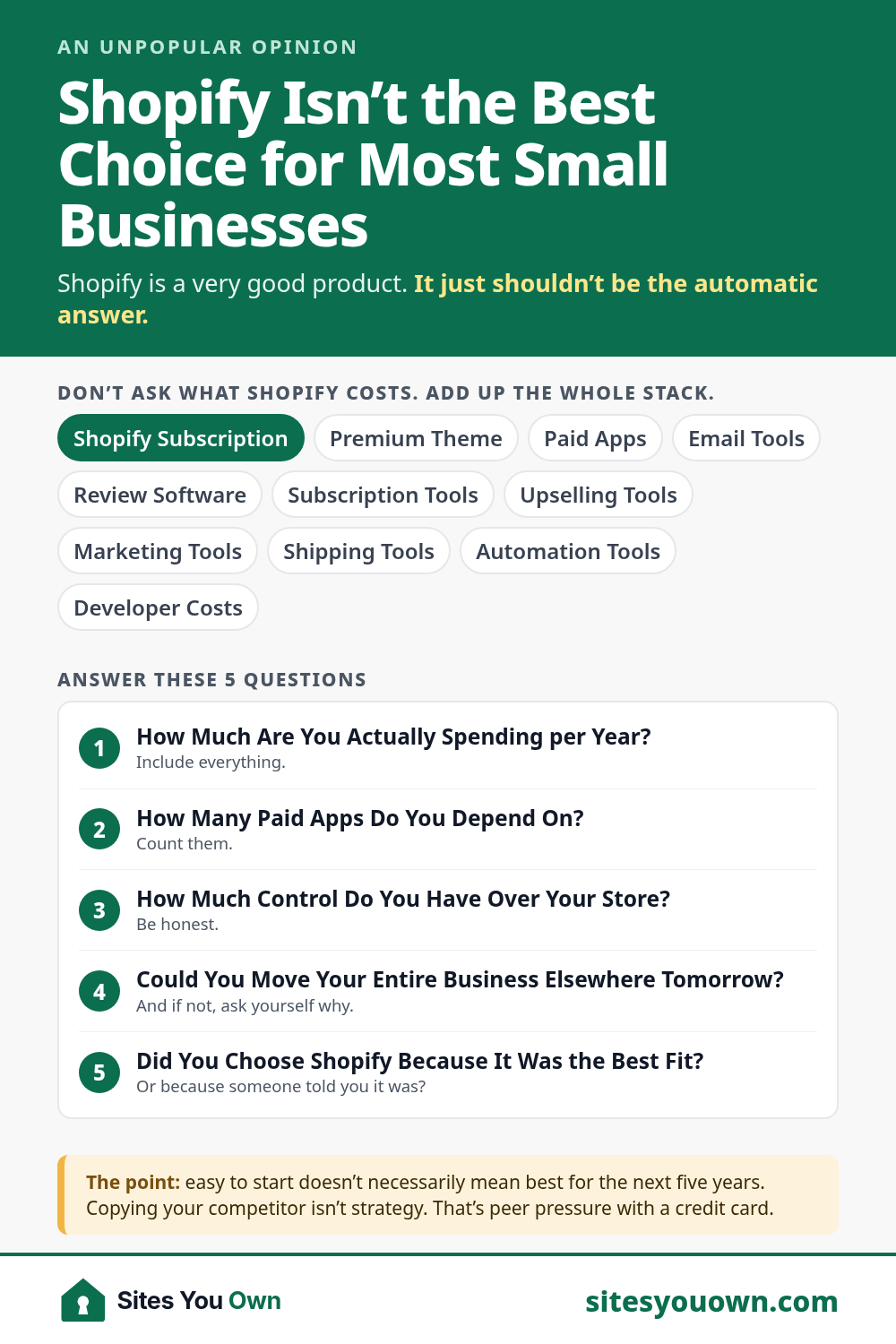
“How much does my entire Shopify stack cost every year?”
Add up:
- Shopify subscription
- Premium theme
- Paid apps
- Email tools
- Review software
- Subscription tools
- Upselling tools
- Marketing tools
- Shipping tools
- Automation tools
- Developer costs
Suddenly that innocent little “Shopify is only $X per month” argument starts looking considerably less innocent.
And Then There's WooCommerce
Before the Shopify crowd starts typing angry comments, let's talk about the elephant in the room.
Yes, WooCommerce requires more responsibility.
Yes, you have to think about hosting.
Yes, plugins can conflict.
Yes, someone can absolutely build a terrible WooCommerce website.
But here's the part Shopify fans sometimes conveniently ignore:
You have considerably more control.
- Your hosting.
- Your database.
- Your website files.
- Your plugins.
- Your theme.
- Your code.
- Your content.
- Your SEO structure.
- Your integrations.
- Your data.
You're not renting the entire foundation of your business from one company. (More on who should own your domain and hosting.)
For some businesses, that control is worth far more than convenience.
“But I Don't Want to Deal With Hosting!”
Fair.
Not everyone wants to change the oil in their car, either.
That doesn't mean owning a car is a bad idea.
It means you should decide whether convenience is worth the trade-off.
If you're selling 20 products from a tiny side business, Shopify might make perfect sense.
If you're building a serious content-driven ecommerce business that depends heavily on SEO, customization, integrations, and long-term control?
Maybe you should look beyond the shiny checkout screen.
Shopify Is Not Bad
This is where Shopify users usually stop reading.
I'm not saying Shopify is bad.
It's actually a very good product.
That's precisely why this argument matters.
Shopify is excellent for certain businesses.
If you want:
- Fast setup
- Managed infrastructure
- A polished ecommerce environment
- Minimal technical maintenance
- A straightforward selling experience
Shopify can be an excellent choice.
But here's where I disagree with the industry:
Shopify shouldn't automatically be the default answer to “I need an online store.”
That's lazy advice.
Small Business Owners: Stop Choosing Technology Like Everyone Else
Your competitor uses Shopify.
Your friend's cousin uses Shopify.
The YouTube tutorial uses Shopify.
The marketing agency recommends Shopify.
So you use Shopify.
That's not strategy.
That's peer pressure with a credit card.

Your business has different requirements.
- Maybe you need a content-heavy website.
- Maybe SEO is your primary acquisition channel.
- Maybe you need unusual product configurations.
- Maybe you need extensive customization.
- Maybe you already have WordPress.
- Maybe you want complete control over your website.
- Maybe you don't want your business model constrained by what an app or platform allows.
Then why are you automatically choosing Shopify?
The Shopify Challenge
So here's my challenge to Shopify users.
Don't defend Shopify by telling me:
“It's easy.”
I know.
Don't tell me:
“Everyone uses it.”
That's not an argument.
And please don't tell me:
“I've never had a problem with it.”
That's great.
Neither have millions of people with other platforms.
Instead, answer these five questions:
1. How Much Are You Actually Spending per Year?
Include everything.
2. How Many Paid Apps Do You Depend On?
Count them.
3. How Much Control Do You Have Over Your Store?
Be honest.
4. Could You Move Your Entire Business Elsewhere Tomorrow?
And if not, ask yourself why.
5. Did You Choose Shopify Because It Was Genuinely the Best Fit?
Or because someone told you it was?
That last question is the one I really want you to think about.
So What Should You Use Instead?
There isn't one universal answer.
For some businesses:
Shopify wins.
For others:
WooCommerce wins.
For highly customized stores:
A custom ecommerce platform might win.
For tiny businesses:
A simple website with a payment system might be all you need.
The mistake is assuming there is one platform that should work for everyone.
There isn't.
Final Thought
Shopify has done an excellent job convincing the world that starting an online store should be incredibly easy.
And it should.
But easy to start doesn't necessarily mean best for the next five years.
So if you're a Shopify user, here's my challenge:
Don't tell me Shopify is the best platform.
Tell me why it's the best platform for your particular business.
And if your entire argument is:
“Because it's easy.”
You might want to look at what you're actually paying for that convenience.
Your Turn
Are you genuinely happy with Shopify?
Or did you simply get comfortable with it?
Let's argue. 👇
Want a second opinion on your store? Book a free 20-minute call and we'll look at your setup together.